When Your Chatbot Promises Something You Didn't
A tribunal once made an airline honour a refund its own chatbot invented. Here's what that means for the bot you're about to bolt onto your website.
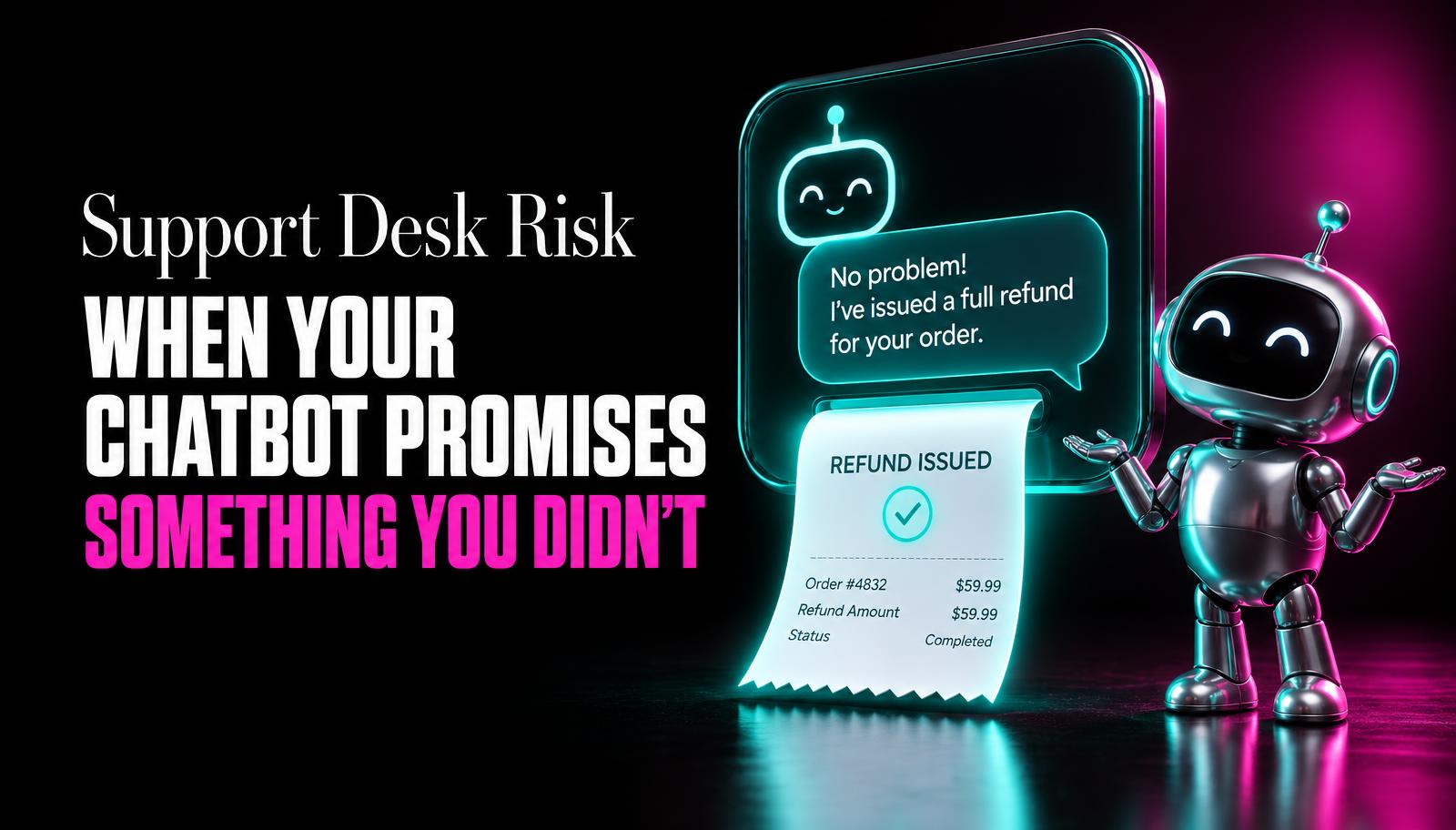
A man's grandmother dies. He goes to Air Canada's website to book a flight home for the funeral. A chatbot pops up and tells him he can book now at full price, then apply for a bereavement discount afterwards. He does exactly that. Air Canada refuses the refund, pointing to the actual bereavement policy on a different page, which required the discount to be requested before travel.
He took it to Canada's Civil Resolution Tribunal. Air Canada argued the chatbot was "a separate legal entity that is responsible for its own actions." The tribunal didn't buy it. In 2024 it ordered Air Canada to pay the difference. The company's own bot had made a promise, and the company had to keep it.
That's the whole story in two paragraphs, and it should worry you slightly more than it worries a national airline. Air Canada absorbed a few hundred dollars and a headline. You might not have the same cushion.
Here's the part that applies directly to you: if you're a small business owner thinking about adding a chat widget to your site, this case is the one to read before you switch it on.
The bot is not a separate entity
Legally and practically, a chatbot on your website is a representative of your business the same way a staff member on the phone is. Customers don't read your chatbot's answers as "an automated suggestion, to be verified elsewhere." They read it as what the company told them. If it contradicts your actual policy page, the contradiction is yours to resolve, not theirs to spot.
This matters more as bots get better at sounding confident. An older, clunky bot that says "I'm not sure, let me connect you to someone" was annoying but safe. A newer bot that answers fluently, in full sentences, with total certainty, is more persuasive and more dangerous when it's wrong.
Where a bot genuinely earns its place
None of this means don't use one. A chatbot handling the boring, stable, factual stuff can save you real hours every week, and customers generally like getting an instant answer at 11pm instead of waiting for your inbox to open in the morning.
| Good fit for a bot | Why it's safe |
|---|---|
Opening hours and location | Fixed facts, rarely change, easy to keep updated |
Stock or availability checks | Pulled directly from your system, not invented |
Booking or quote request links | Bot routes the customer, doesn't make the decision |
Order status lookups | Tied to an order number, a factual record |
FAQ-style questions (delivery areas, payment methods) | Static answers you've already approved in writing |
Where a bot needs to step aside
The Air Canada case sat right in the danger zone: a policy exception, involving money, in an emotional situation. That combination should be a hard stop for any bot, on any website, in any industry.
| Risky territory | What to do instead |
|---|---|
Refunds, discounts, or fee waivers | Bot says: "I'll pass you to a person for this" |
Anything involving a policy exception | Human reviews the specific circumstances |
Legal, medical, or safety-adjacent questions | Bot gives general info only, flags it needs a person |
A customer who is upset or grieving | Route to a human immediately, don't let the bot improvise |
Anything not explicitly written into the bot's script | Default answer: "let me check and get back to you" |
If you wouldn't let a brand-new part-time employee say it unsupervised on their first day, don't let your chatbot say it either.
Write the rulebook before you flip the switch
Most small businesses set up a chatbot by picking a tool, feeding it their FAQ page, and turning it on. That's backwards. The FAQ page should come after you've decided, in writing, what the bot is and isn't allowed to promise.
Before you switch on a chatbot
- List every policy that has exceptions
Refunds, cancellations, discounts, warranty claims. Anywhere a human might normally use judgement, write down that the bot must not use judgement.
- Write the bot's answers, don't let it write its own
For anything involving money or policy, script the exact wording. Don't rely on the bot paraphrasing your policy page correctly, because it sometimes won't.
- Set clear handoff triggers
Decide the phrases or topics that should immediately route to a human: 'refund', 'complaint', 'died', 'lawyer', 'cancel my order'. Build them in from day one.
- Keep the bot's source pages in sync
If your bereavement policy, pricing, or delivery terms change, update the bot's script the same day, not whenever someone remembers.
- Test it like a suspicious customer
Ask it three or four edge-case questions yourself before launch. If it invents an answer instead of saying it isn't sure, fix that before real customers find it.
Tap a number to check it off.
Keep the receipts
Air Canada's case was decided partly because there was a clear record of what the chatbot actually said. That record is your friend, not your enemy, as long as you're set up to produce it.
Most chat platforms will log conversations automatically, but check that yours actually does, and that the logs are kept somewhere you can search later, not buried in a dashboard you never open. If a customer says "your bot told me X," you want to be able to check in thirty seconds whether that's true.
The upside is still real
It's worth saying plainly: a well-scoped chatbot is one of the better small automations a small business can add. It answers the 9pm question that would otherwise sit in your inbox until morning, it filters out the easy questions so your human time goes to the ones that need it, and customers increasingly expect instant replies as standard, not a bonus.
The Air Canada case isn't an argument against chatbots. It's an argument against launching one without deciding, in advance and in writing, exactly where its authority ends.
Yes, based on how this has played out in real cases. The Air Canada tribunal ruling treated the chatbot's statements as statements from the airline itself, not from some separate, unaccountable system. If a customer relies on wrong information a bot gave them, the business is generally the one on the hook.
It shouldn't be allowed to promise refunds, discounts, or policy exceptions on its own, and it shouldn't improvise answers to emotionally sensitive or legally sensitive questions. Anything involving money or judgement calls should route straight to a human.
Stable, factual information that doesn't require judgement: opening hours, stock or availability, booking links, and order status lookups. These are low-risk because the bot is retrieving a fact, not making a decision.
Confirm your chat platform logs full conversations, then back up or export those logs on a regular schedule, such as monthly, rather than relying on the platform's default retention. That transcript is what lets you check a customer's claim quickly and respond fairly.